Suitable to find patients with (very) poor exercise tolerance
Linked to prognosis in many NCDs
Ceiling effect
Less suited for ‘milder’ disease or younger people
Picking up modest decrease in VO2peak particularly in younger patients is difficult
Less responsive to interventions in such patients (better use endurance tests)
A result less than 300-350m is indicative of poor prognosis
In patient populations
Timed walking tests -> 2-4-6-12 min duration
Paced walking tests -> pace is fixed, more incremental
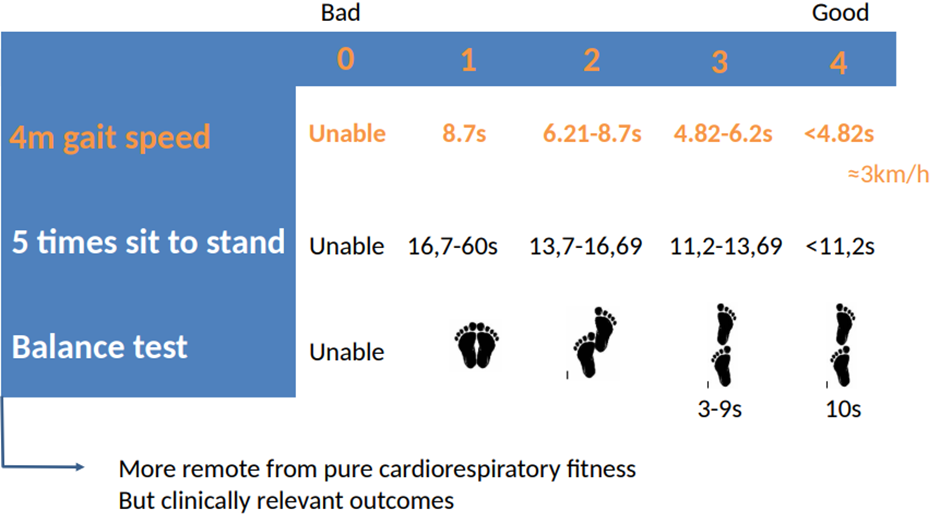
Test specifically used in frailty
Comfortable walking speed -> distance
4m gait speed
More remote from pure cardiorespiratory fitness (not the best measurement of exercise capacity, but related to frailty in the elderly, like in a nursing home)
Short Physical Performance Battery (SPPB)
Alternatives
1 minute STS (e.g. in primary care)
Evaluation – estimate of physical fitness
Typically, with assessment of HR, StCO2, dyspnoea & fatigue)