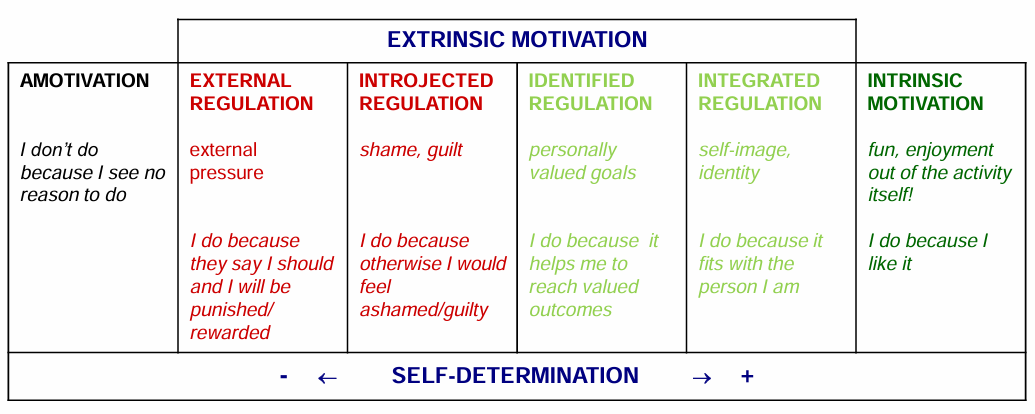
We want to bring people from controlled into autonomous motivation
Green: Autonomous forms of motivation, positively related to long-term adherence
Red: Controlled forms of motivation, negatively related to long-term adherence, but positive correlation with short-term adherence
By trying to satisfy these needs, a process of internalisation occurs on a continuum of motivation, which makes it more likely that we will go from controlled to autonomous motivation.
Amotivation
The relative absence of motivation
A lack of contingency between actions and outcomes is perceived
Reasons for continuing involvement cannot be found
Self-selection bias in research doesn't allow us to test these people
"I do not see why anyone would do physical activity"
External Regulation
Behaviour is controlled by rewards, threats and possible coercion
Behaviour will stop once the rewards or threats are gone
"If I don't come to class, I will be punished"
"The doctor told me to come"
Introjected regulation
The individual is acting out of avoidance of negative feelings, such as guilt, shame or norms that have been taught
"If I don't do sport I feel guilty"
Identified regulation
Action motivated by an appreciation of personally valued outcomes of participation or the goals related to the activity
"I come to the class because it will help me understand the content and pass the exam"
Integrated regulation
The behaviour is performed to satisfy goals that are symbolic of the person’s identity (i.e., they are ‘integrated’ with the self)
"I feel that, as an university student, it's important to attend classes"
"I do interval trainings because that is what a real runner does"
Intrinsic motivation
You perform the activity because you enjoy the activity itself
"I genuinely enjoy running"
Beware!!
The quality of motivation for the same behaviour can vary over time and even from day-to-day (e.g., my motivation for running during the week).
A behaviour can consist of a number of subbehaviours with different types of dominant motivations (e.g., your motivation to become a physical activity coach versus your motivation to follow a specific course)
Identified regulation: there is a distinction between ‘bad’ (external) goals and ‘good’ (internal) goals (example: appearance vs. health, social approval vs. social belongingness)
The difference is not always clear-cut
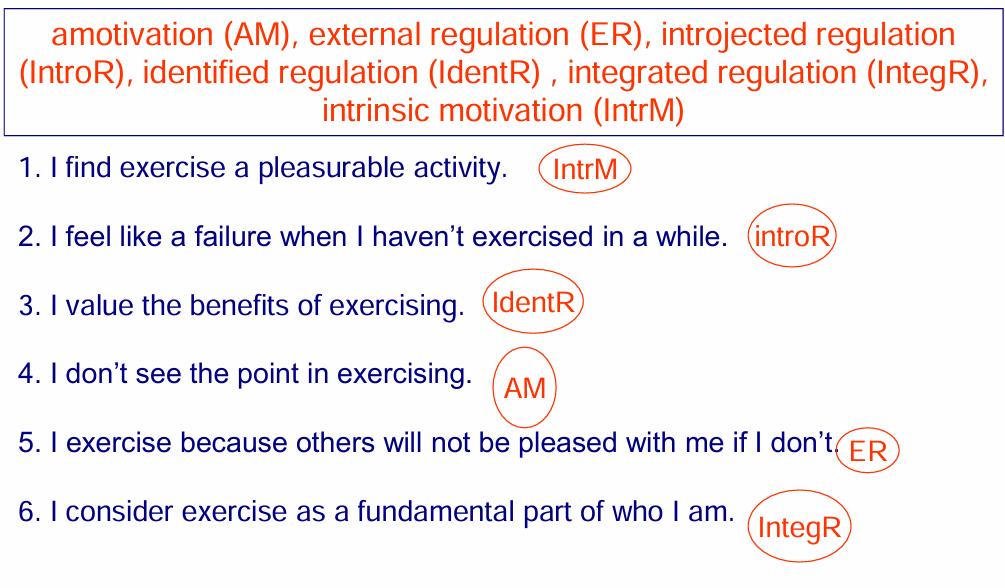
Sample items for types of motivation - BREO -3 questionnaire
The research concludes that the more self-determined the activity, the more likely it is that the activity will be continued over a longer period of time.
We can make people more autonomously motivated by being need-supportive