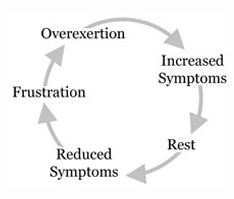
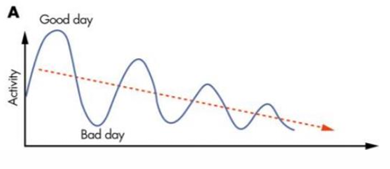
Step 1: Becoming aware of the boom/bust or push/crash pattern
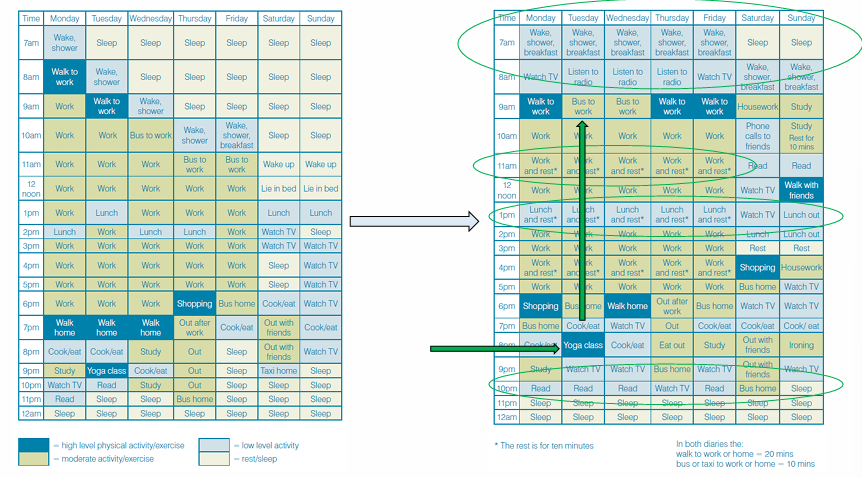
can use a colour diary to find the intensity
Example:
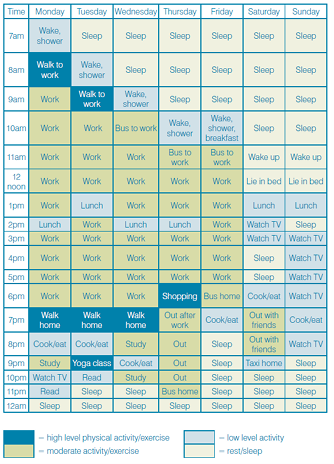
This diary of a boom bust pattern shows how the patient has a busy working week with an irregular sleeping pattern, long working hours, overactivity early in the week with walks to and from work, erratic meal times and little time for resting.
As a consequence, this patient arrives at work later each day as he/she becomes more tired during the week.
The patient is unable to do much at the weekend and has to cut short an evening out with friends on Saturday
Step 2: Understanding the energy concept
The "Spoon Theory"
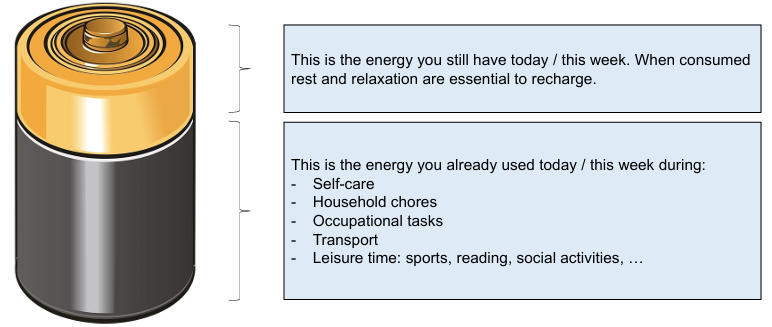
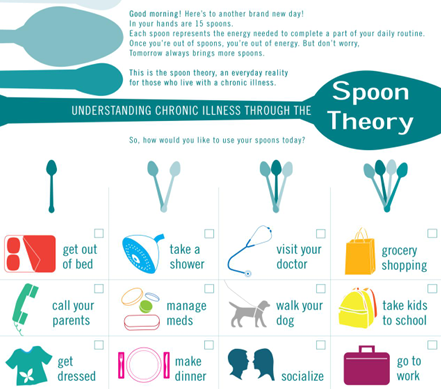
The “spoon theory” explains that someone who has a chronic health condition starts each day with a limited amount of energy, represented by a spoon.
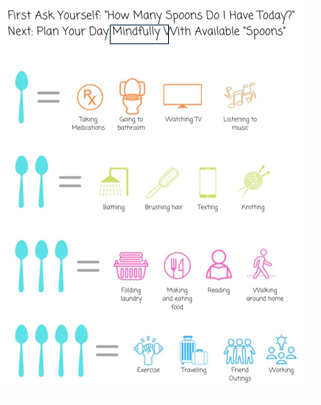
When you perform an action, you "spend" a spoon. When you have spent all your spoons, you are exhausted mentally or physically and can no longer perform even easy tasks
The spoons metaphorically symbolized how for individuals with chronic illness, energy is limited and dependent on multiple factors, such as stress and pain.
While able-bodied people can fulfill daily activities with seemingly enough spoons, individuals with chronic illness can only get a handful of spoons each day to expend.
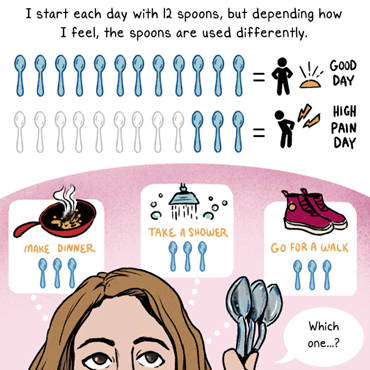
Depending on their illness and factors, some individuals have less spoons some days, and more spoons on other days.
Likewise, a certain task can take up less spoons some days, and more spoons on other days.
Individuals with chronic illness have to carefully plan their day to ensure that their energy does not dissipate quickly.
If they attempt to use more spoons than allocated, they can experience worsened symptoms, an illness and/or fewer spoons the next day.
It allows individuals to estimate how many spoons each task requires, visualize their available energy levels and select which tasks to prioritize within their means.
Step 3: The importance of rest
Step 4: Stabilising the routine
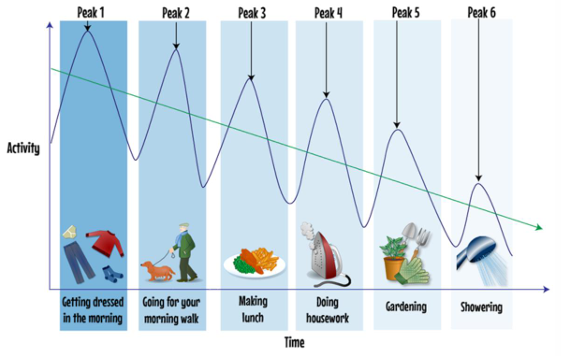
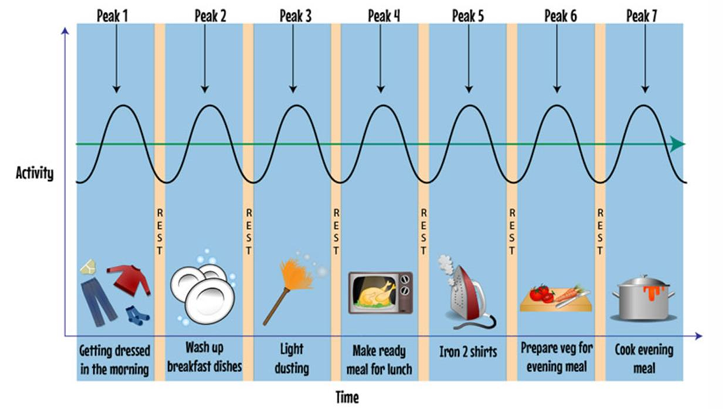
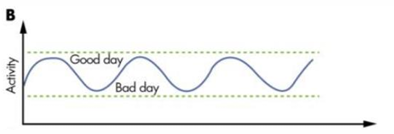
It is important that patients learn to stabilize their daily routine: they need to work out a consistent schedule that spreads their activities over a week and throughout each day to avoid a boom/bust pattern
Patients should aim to do a similar amount of physical activity each day
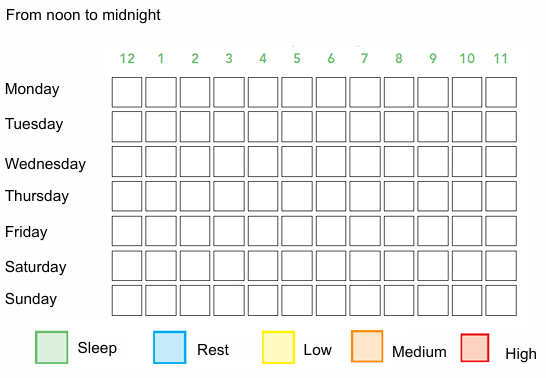
To start stabilising the routine, the patient need to work out first their current schedule by filling in a activity diary for one week.
This should include times that the patient spend sleeping and resting, and everything that they do graded into low, medium and high activities.
They could make a note of how long a task takes if it is less than an hour.
Completing such a diary for a week should help the patient to identify patterns in their daily routine.
Use this information to help a patient to modify their activities so they can balance high, moderate and low activity level tasks to reduce the risk of continuing, or entering, a deconditioning cycle
Evidence for pacing for fatigue in people with chronic conditions
Pacing might have sustained beneficial effects on fatigue management, in particular on fatigue reduction.
It is feasible and effective in optimizing participation in desired daily life activities.