Added value of resistance training?
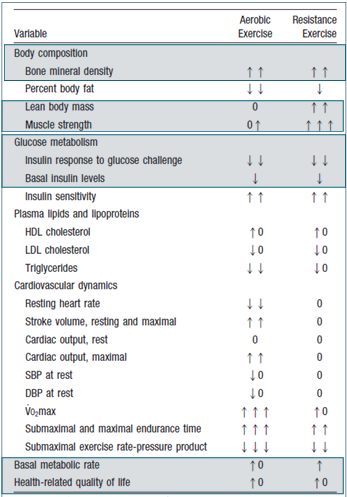
Trainable characteristics of muscular fitness
- Muscular strength and endurance
- Greater important in general training program focusing on health/fitness
- muscular power

Type - Resistance exercise program
- Isometric strength training: secondary role
- Dynamic strength training: primary role
- Concentric: shortening
- Eccentric: lengthening
- Isokinetic resistance training
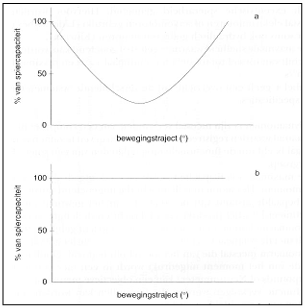
Isometric
- Hettinger and Muller (1953): significant gains in isometric strength (5%/week) by holding one 6 sec contraction at 2 third of maximum intensity, 5 times/week
- Widely used in rehabilitation programs to counteract strength loss, muscle atrophy
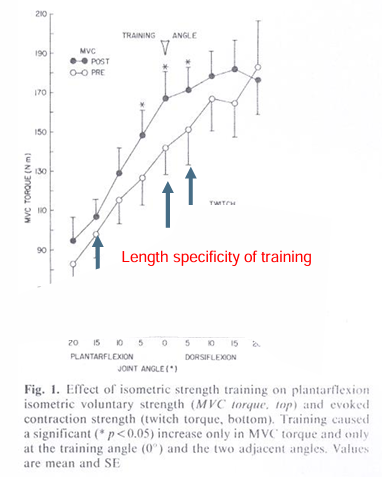
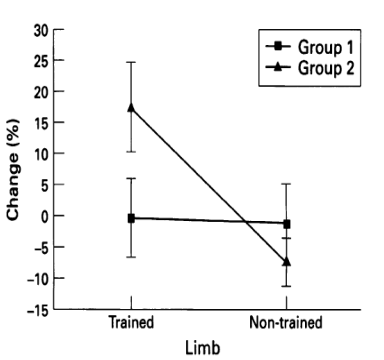
- !! Specific for joint angle
- i.e. strength gains at angles other than the training angle are 50 % less than those at the exercised angle
- i.e. strength gains at angles other than the training angle are 50 % less than those at the exercised angle
Guidelines

Dynamic
- Involves concentric and eccentric contractions of the muscle group, performed against a constant or variable resistance.
- Free weights
- Constant or variable resistance machines
- Dynabands
- …
- Eccentric vs concentric contractions
- Generation of greater force per unit of muscle size
- More neuromuscularly efficient
- Less metabolically demanding
- More conducive to hypertrophy
- More delayed onset muscle soreness
Strength improvements are largest with inclusion of both concentric and eccentric contractions!
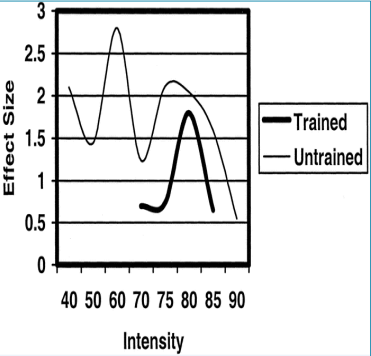
Intensity
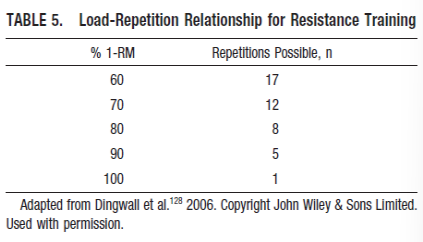
- % of 1RM or nRM
- Depends on patient’s experience/fitness level and patient’s goals
- Muscle Strength & Mass:
- Minimal load: 30% van 1RM (older, frail,…)
- Recommended load: 60-100% van 1RM
- 60-70% of 1RM 8-12 reps: novice exercisers
- 70-80% of 1 RM (6-12reps) intermediate lifters
- 80-100% of 1RM: advanced lifters
- +2-10% for progression based on muscle size and involvement
- Muscular endurance:
- 30-50% of 1RM
- high repetitions (15-20 or more)= long-duration sets or minimal recovery between sets
- Progression through decrease in rest or increase in volume (through multiple sets)
- Relation between increases in strength and increases in muscle endurance
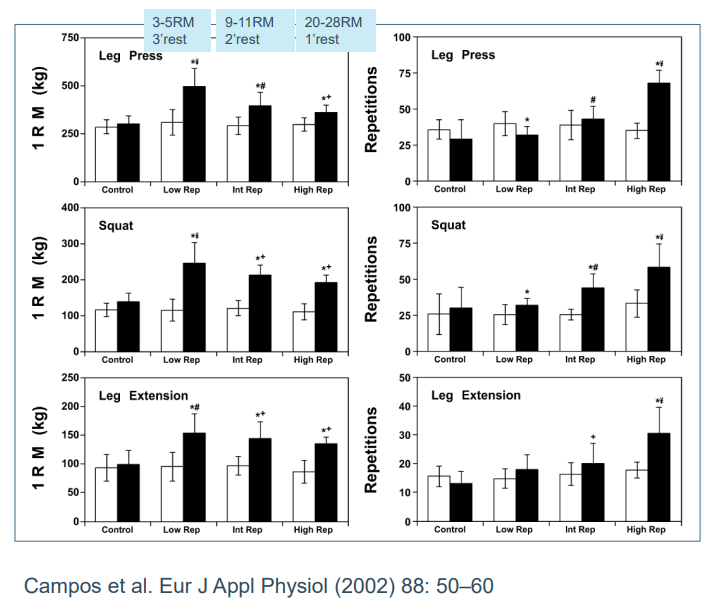
Rest Periods
- Amount of rest between sets and exercises affects
- metabolic, hormonal, cardiovascular responses to an acute bout of resistance exercise
- Performance of subsequent bouts
- Training adaptations
- General fitness program for strength:
- 2-3 minutes: multiple joint exercises using heavy loads
- 1-2 minutes: assistance exercises
- General fitness program for endurance
- 1-2 minutes: high repetition sets (> 15)
- < 1minute: moderate repetition set (10-15)
Frequency
- Optimal frequency:
- Novice/intermediate: 2- 3 days / week for EACH muscle group
- More is better
- Two can be equally effective as 3 days per week if volume = equated
- 48 hours of rest between sessions for same muscle group
- Whole body versus Split routine: both equally effective
- E.g. Monday and Wednesday: hips and legs, lower back
- Tuesday and Friday: upper back, chest and shoulder
- Novice/intermediate: 2- 3 days / week for EACH muscle group
Volume
= sum of repetitions during training sessions x load
- How to establish progression
- Number of exercises
- Number of sets/exercise
- Number of repetitions/set
Which exercises and Order of exercises
- AIM of your program
- Muscular Strength
- Single joint vs multiple joint exercises
- Muscular endurance
- Multi-joints and / or large muscle groups
- Muscular Strength
- Free weights vs Machines
- Machines: safer, easy to learn and allow the performance of some exercises that may be difficult with free weights. They help to stabilize the body and limit movement about specific joints involved in synergistic force production
- Free weight: can result in a pattern of intra and intermuscular coordination that mimics the movements required for a specific task.
- Progression: from free weights and machine exercises to emphasis on free weights
- ORDER: sequencing of exercise affects the ACUTE expression of muscular strength
- General
- Multi-joint before single joint exercises
- When training all major muscle groups in a workout;
- Large muscle groups before small muscle groups
- Multi joint before single joint
- OR rotation upper/lower body
- When exercising upper body muscles on one day and lower body on a separate
- Large before small
- Multijoint before single joint
- Or rotation of opposing muscles
- When training individual muscle groups
- Multijoint before single
- Higher intensity before lower intensity
- General
Which exercises
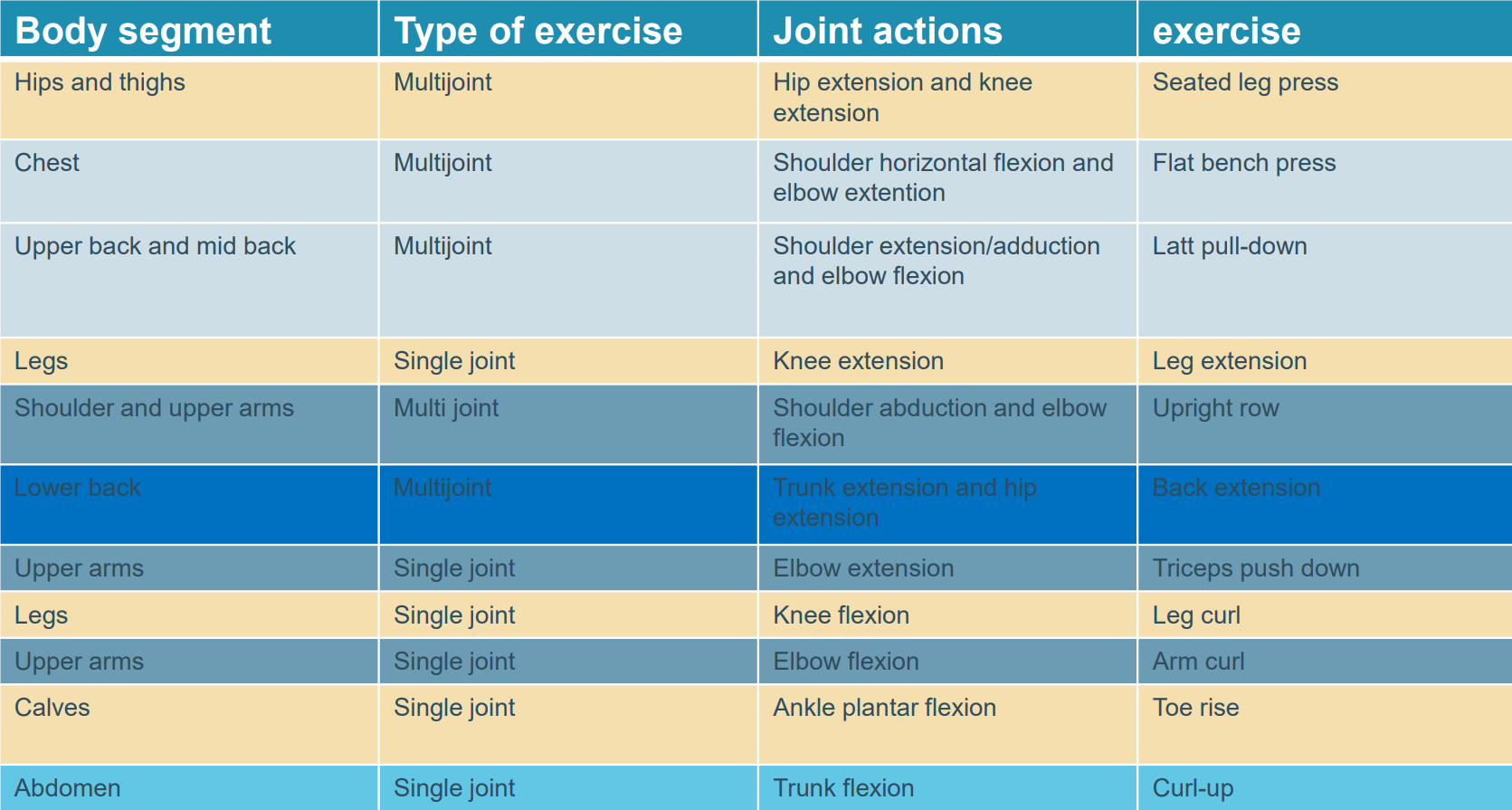
- Multi-joint: chest, shoulders, back, hips, legs, trunk and arms
- Single joint:, abdominals, lumbar extensors, calf muscles, hamstrings, quadriceps, biceps,…
- Muscle BALANCE!!!
- Opposing muscles: Agonist vs antagonist
- Contralateral muscles: Left and right
- Upper vs lower body
- Technique, technique, technique!!!!
- Movements in controlled manner
- Always through full range of motion
- Proper breathing technique
Example of exercise order - basic resistance training program
Velocity of muscle action
- Intent to lift the weight as fast as possible is critical for maximizing strength
- Compared with slow velocities, moderate (1–2 s concentric: 1–2 s eccentric) and fast 1 s concentric, 1 s eccentric) velocities have been shown to be more effective for enhanced muscular performance (e.g., number of repetitions performed, work and power output, volume)
- For maximizing endurance: time under tension!!!
ACSM Progression models in healthy adults
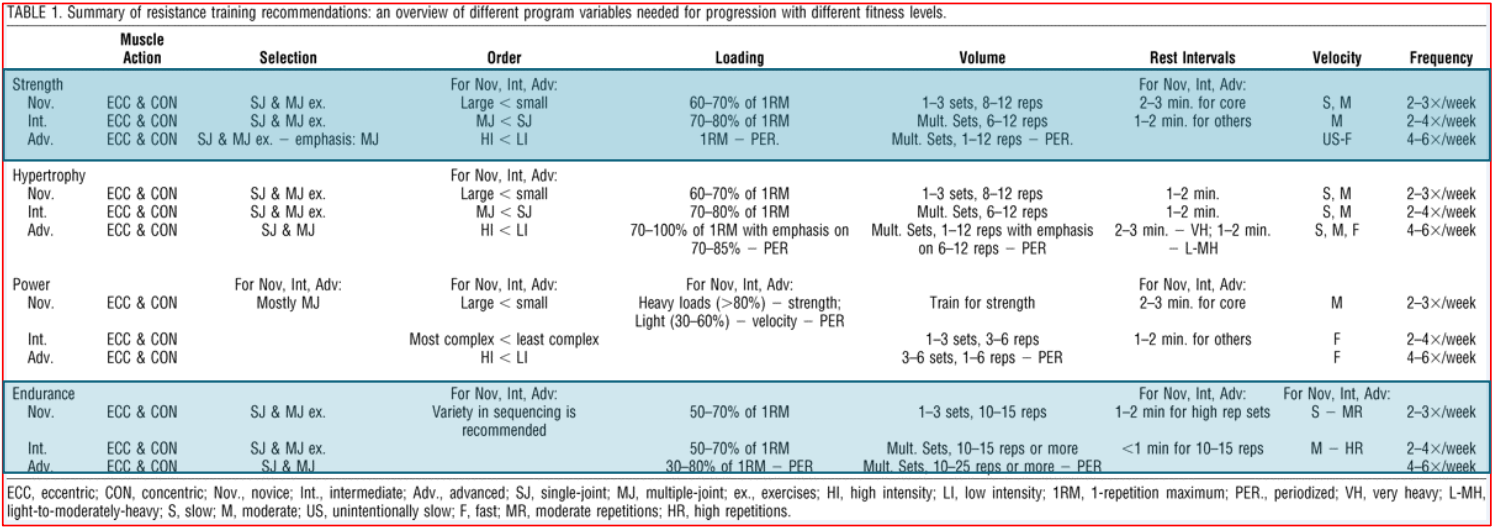
Components of a single exercise session
- Warm-up
- Conditioning phase: FITT principle -20-60 minutes
- Cool-down
- Stretching - flexibility
Warm-up
Why?
- To allow the body to adjust to the changing physiological, biomechanical and bioenenergetic demands placed on it during the conditioning phase
- Increase blood flow to working cardiac and skeletal muscles
- Increases body temperature
- Decreases the chance for muscle and joint injury
- Reduce the potential for after-exercise muscle soreness
- Lessen the chance for abnormal cardiac rhythms
How?
- Gradual increase in intensity
- low (< 40% HRR) to moderate(40-60% HRR)
- 5-10 minutes
Cool-down
- To reduce the risk of cardiovascular complications
- to allow a gradual recovery of heart rate and blood pressure to baseline levels
- Prevents pooling of blood in extremities
- Reduces possibility of dizziness and fainting
- removal of metabolic end products from the muscles
- Gradual decrease to low intensity
- 5-10 minutes
Stretching
- to reduce the change of muscle cramps or muscle soreness
- 10 minutes
- after the warm-up or cool-down phase
Summary - Guidelines for health and fitness
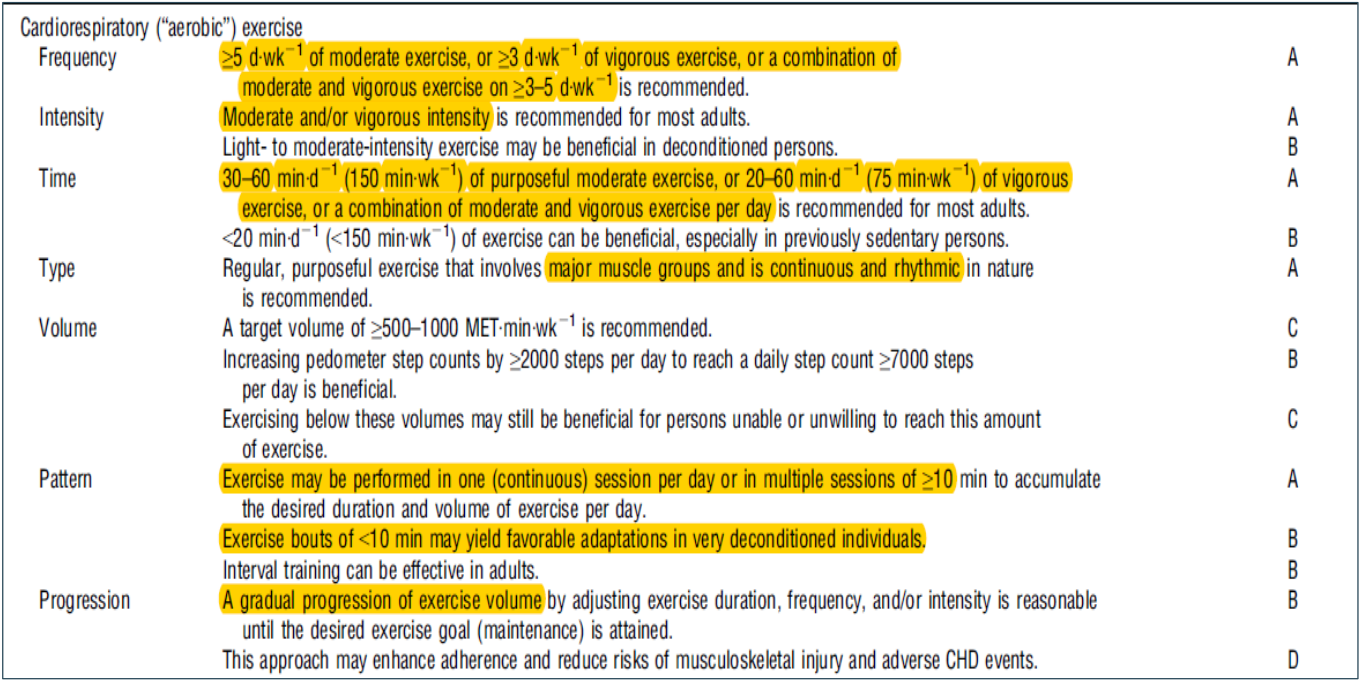
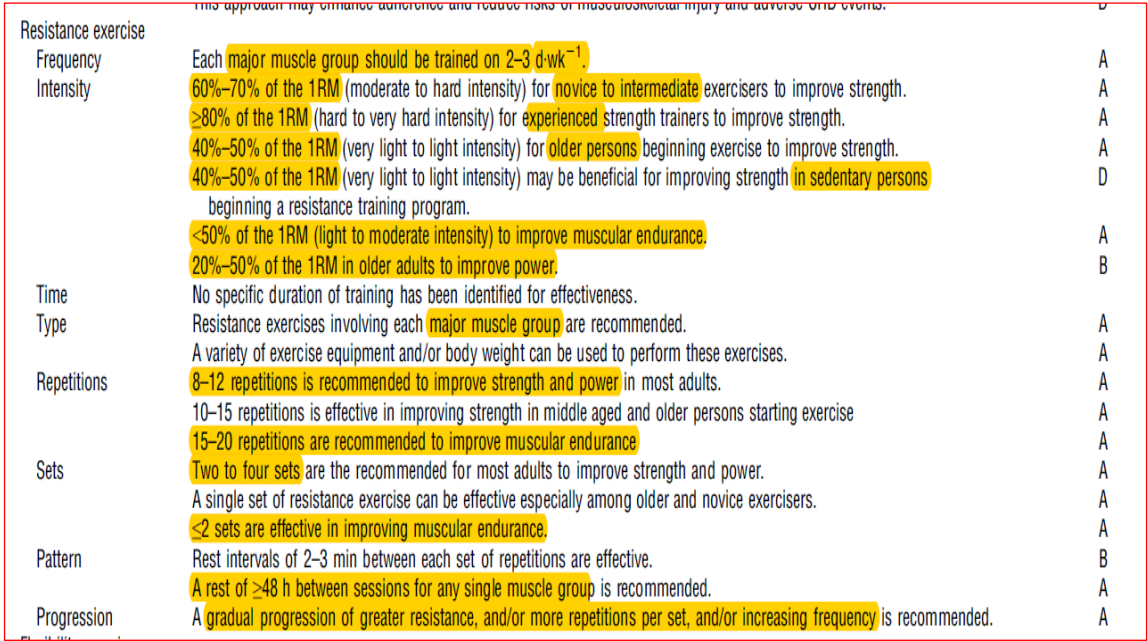
Enhancing adherence
- Emphasize and monitor the acute and immediate effects of exercise
- Search for variety and enjoyment in the exercise program
- Establish a regular schedule of exercise and monitor!
- Minimize muscle soreness and injury by participation in exercise, particularly in the early phase of exercise adaption.