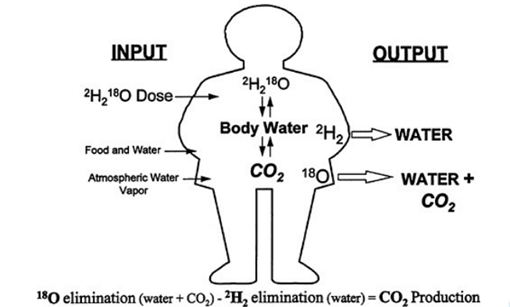
- Biochemical procedure that can estimate EE through biological markers that reflect the rate of metabolism in the body
- Ingestion of a standardised amount of 2 stable isotopes of water 18O and 2H
- The isotopes distribute themselves in equilibrium with the body water
- Urine samples are collected at the beginning and end of the measurement period
- Difference in elimination rates of the isotopes provide a measure of CO2 production and therefore EE
- Pros
- Accurate and valid measurement of EE
- Applicable for children and adults
- Induces no change in PA behaviour
- Usual movement pattern
- Cons
- Expensive: not for large-scale studies
- Requires expertise
- No indication of PA pattern, only EE
Powered by Forestry.md