- MET = metabolic equivalent
- the ratio of the work metabolic rate to resting metabolic rate
- one MET -> 1kcal/kg/hour
- roughly equivalent to the energy cost of sitting quietly
- a MET is also defined as oxygen uptake in ml/kg/min with one MET = 3.5ml/kg/min -> oxygen cost of sitting quietly
- one MET -> 1kcal/kg/hour
- compendium
- used in epidemiological studies
Intensity
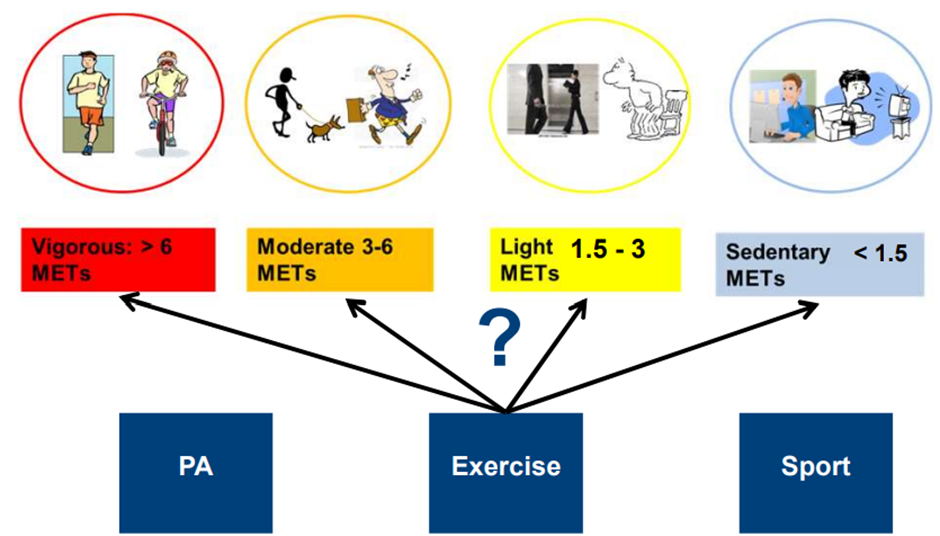
MET-values
At least 1 exam question on MET values
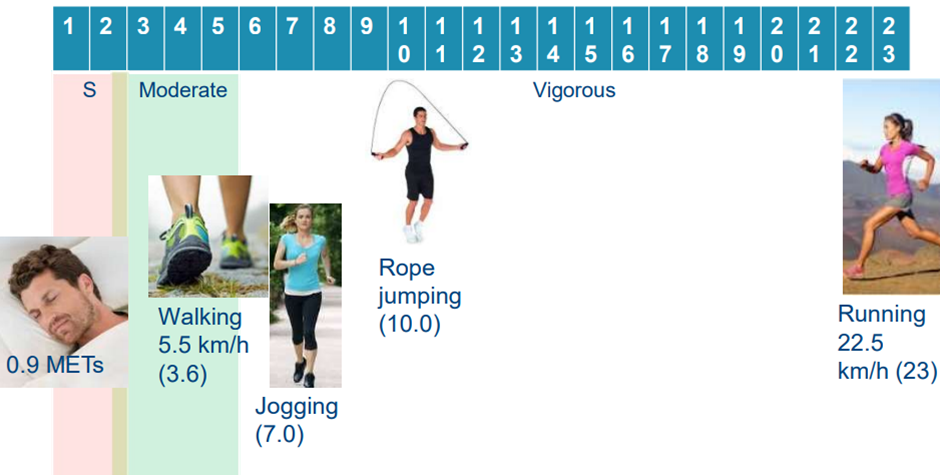
PA volumes
- MET values often used to estimate PA volume or energy expenditure in studies using surveys to measure PA
- Simple way to report PA level in one number
- Used to examine associations PA – range of health outcomes
- E.g. 30 min jogging & 10 min rope jumping à PA volume
- 30 x 7 METs + 10 x 10 METs = 310 MET.minutes
- 310 MET.minutes/60 mins = 5.2 MET.hours
- 0.5 x 7 METs + 0.15 x 10 METs = 5.2 MET.hours
- 30 x 7 METs + 10 x 10 METs = 310 MET.minutes
- E.g. 90 minutes walking at 5.5km/h --> PA volume
- 90 x 3.6 METs = 324 MET.minutes
PAL volumes
- PAL = physical activity level
- average daily EE expressed as a multiple of 1 MET
- = total daily EE/RMR
- typically ranges from 1.1 to 2.4
- average daily EE expressed as a multiple of 1 MET
Example
- 1 MET - RMR
- 24 hours -> 24.0
- Person does
- 8 hours sleep - 0.9 MET
- 7 hours sedentary - 1.5 MET
- 5 hours light - 2.0 MET
- 3 hours moderate - 4.0 MET
- 1 hour vigorous - 7 MET
- Total = 7.2 + 10.5 + 10.0 + 12.0 + 7.0 = 46.7
- PAL = 46.7/24.0 = 1.9
- Total = 7.2 + 10.5 + 10.0 + 12.0 + 7.0 = 46.7