- In the BST, participants must maintain an isometric prone trunk extension for as long as possible.
- Hypotheses:
- If a participant has low self-efficacy regarding their ability to hold the position, they may terminate the test early, regardless of their actual muscular endurance.
- Conversely, high self-efficacy can help individuals persevere longer, reflecting a more accurate measure of trunk extensor endurance.
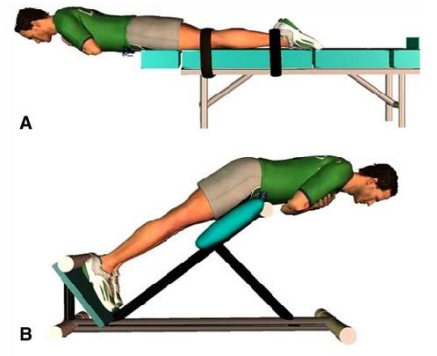
- A physical assessment used to measure trunk extensor muscle endurance.
- During the test, the participant lies prone on a table with the upper body unsupported past the pelvis, while the lower body is fixed.
- They hold their torso in a horizontal position for as long as possible, and the duration is recorded as an indicator of muscular endurance and back stability.
- It is commonly used in clinical settings to evaluate risk of low back pain (< 60 sec) or effectiveness of interventions targeting back muscles.
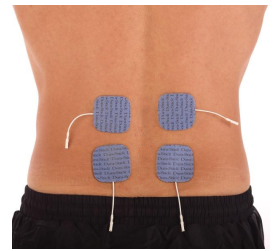
- The EMG measures the electrical activity of muscles while they contract.
- In BST, electrodes are placed on the trunk extensor muscles (mainly the erector spinae).
- The EMG signal shows how hard the muscles are working and how fatigue develops over time.
- Muscles naturally fatigue over time, which shows as a change in the EMG signal, typically an increase in amplitude and/or a shift in frequency.
- Researchers can predict when the person would reach maximal fatigue, even if they stop earlier due to discomfort or lack of motivation.
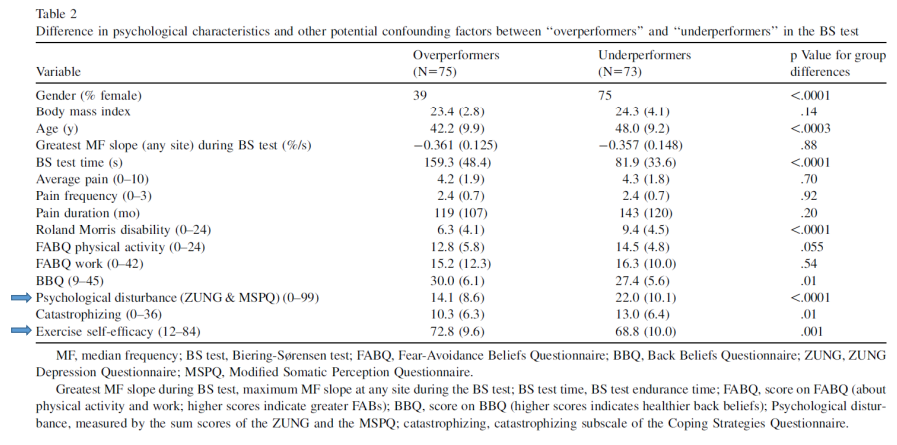
- These findings underscore the importance of considering psychological factors, such as self-efficacy, when interpreting physical fitness results.
- Participants' confidence in their ability to perform the test can influence their performance, potentially affecting the accuracy of the assessment.
- Incorporating self-efficacy assessments can provide a more comprehensive understanding of an individual's trunk muscle endurance.
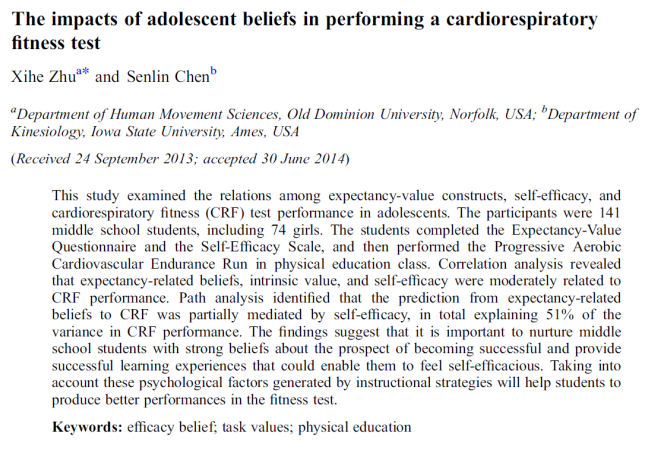
- Hypothesis: Expectancy-value constructs from expectancy value theory directy influence test performance by also indirectly via self-efficacy.
Pacer test (Beep test)
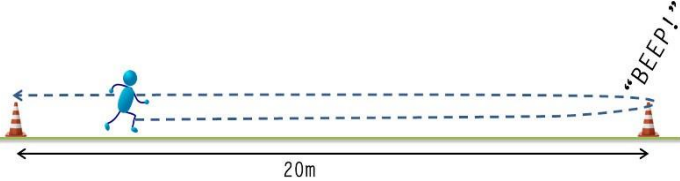
- The test involves running back and forth between two points 20m apart. Each run must be synchronized with a pre-recorded audio track which plays beeps (hence the name ‘beep test’) at regular intervals.
- Over the course of the test, the participant progresses up through various levels (lasting just over a minute each), with the beeps getting faster at each new level reached.
- At the point where the participant fails to reach the line before the beep twice in a row, this becomes their highest score and the test is over.
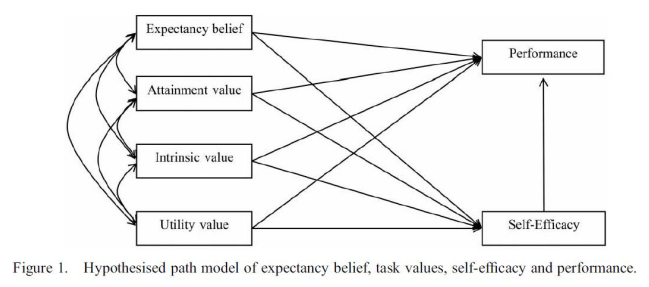
- It was hypothesized that
- both expectancy-value constructs and self-efficacy would positively predict running performance test
- and that self-efficacy would mediate the relation between expectancy-value constructs and performance
Expectancy Value Questionnaire (EVQ)
- The EVQ was adapted to fit the context of running in physical education.
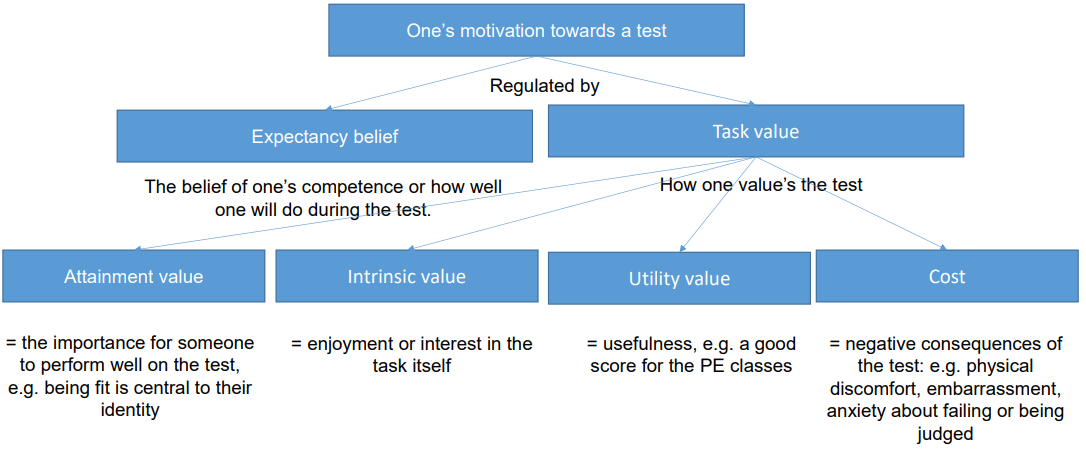
- For instance, one item measuring expectancy-related beliefs read: “How good are you in running?”
- An example item measuring attainment value read: “How important do you think running is for you?”
- An example item measuring utility value stated: “Compared to other activities you do, how useful is running?”
- One item measuring intrinsic value stated: “How much do you like running?”
- Participants were allowed to select only one of the five choices, with 1 = Don’t like it at all, and 5 = Like it very much
Self-efficacy
- Based on Bandura’s (2006) guideline for measuring self-efficacy, a hierarchical scale including 6 statements referencing different levels of performance in PACER was used.
- The statements began with "I am confident that I can run 15 laps in the PACER test" that was followed by five choices between 1 = "Not at all confident" and 5 = "Very confident."
- The other statements in the scale were worded in the same manner but with increasingly higher levels of performance.
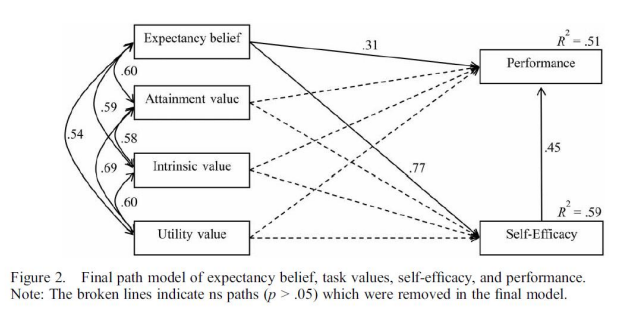
- Expectancy belief = based on one’s longer term and broader belief, e.g. regarding the performance in physical activities in general.
- Self-efficacy = confidence in a specific task
- One’s longer term and broader sense of competence in running has a significant total effect in specific test performance.
- Self-efficacy demonstrated a significant direct effect on test performance: a higher self-efficacy motivated the students to show a better running effort and performance.
- The task values (importance, usefulness, how much one likes it) did not have a significant direct or indirect effect on CRF performance.
We should promote expectancy belief and self-efficacy to elicit better maximal test performances / motivating people towards increasing their performance in general.
- In a practical sense, the 4 sources of self-efficacy should be nurtured:
- Mastery experiences: a practice test if possible (in daily clinical practice not always possible as time consuming or expensive: e.g. a maximal incremental exercise test on an ergometer).
- In maximal tests: offering encouragements prior to as well as during the test: persuasion