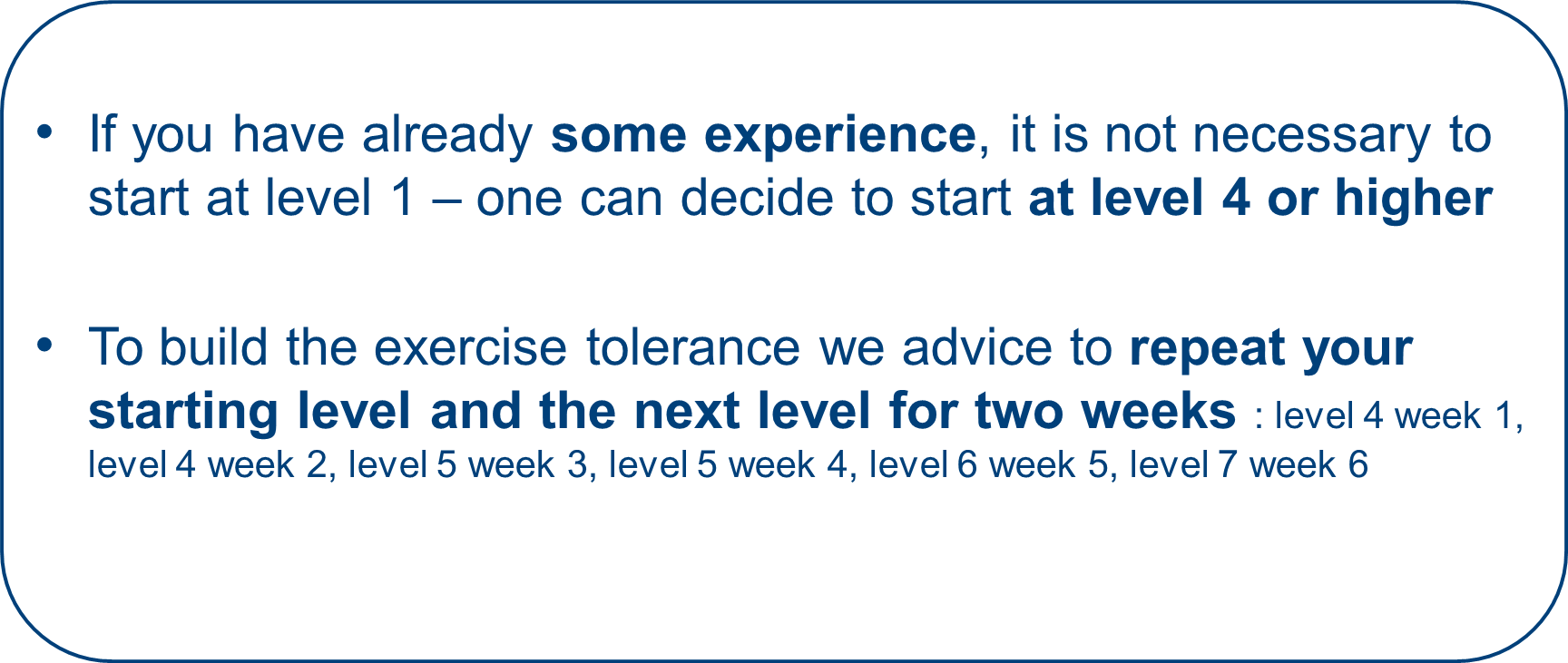
Men, 29 years old, body weight of 70 kg, height 181 cm. He is a nurse, working in the University Hospital UZ Leuven. Recently, he lost one of his best friends to cancer and together with some friends they have decided to join in for some fund raising for Kankerfonds. They will run “20 km of Brussels’ (6 months from now). He used to play soccer in a local team (2 times / week). However, since the birth of his first child (10 years ago), he hasn’t been doing any regular physical activity outside of work. No family history of CAD. No personal history of injuries or diseases
Resting heart rate: 50 bmp
Resting blood pressure: 125/78 mmHg
He did a maximal exercise test which was clinically negative
Peak VO2: 92% of predicted (terminated because of leg fatigue)
Peak HR: 191 bpm
Training adaptations
The body adapts progressively to exercise, this results in:
Improvement of physical fitness
endurance, strength
Improved tolerance for exercise loading
Bone & tendons
Economic running technique
Body composition changes
Designing the training program
Varying by means of training duration (minutes) and training intensity
Duration= The total time of running
To build up tolerance to exercise
The total duration is calculated without taking rest periods
The INTENSITY of running
Determined by running speed
Warning
The body adapts slowly
Ratio exercise/recovery is crucial
Microcyclus
Mesocyclus
Beginners: one day of training followed by one day of rest
Advanced: one day of higher intensity followed by one day of lower intensity
Adaptation of the body costs energy
The body should deliver this energy:
Nutrition is important
May interfere with other stress conditions
Sickness, Fever?
Training Load
Duration of running
Build up gradually
If necessary with intervals of walking
Intensity of running
Keep it low in the beginning
Can increase in the next phase
Running for your health
PHASE 1
From physically inactive to jogging
Start to run from 0-5km in 10 weeks
PHASE 2
From jogging to 20km of Brussels
18 week program depending of the background of the person
Start to run
Building training duration is only possible by combining running and walking (cfr. start to run –see below). Slow progression for beginners:
week 1: +0++00++00+++000+++000
11’ running & 11’ walking
week 5: ++00++++00+++++00++++++00
24’ running & 10’ walking
week 10: 30’ joggen met 1 à 2’ walking
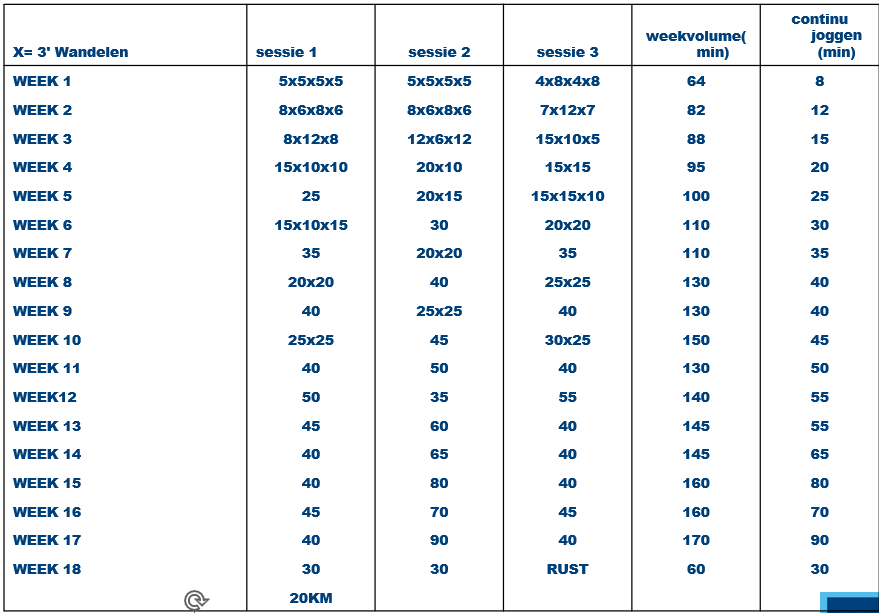
Block 1: week 1-4
Week 1: low volume –low intensity
total volume= 64’ running
3 sessions of about 20’
Longest continuous run=8’
5x5x5x5x (x=3’ walking)
Week 4: moderate volume- low intensity
total volume= 95’ running
3 sessions of 30 à 35’
Longest continuous run=20’
15x10x15 or 20x10
Block 2: week 5-8
Build up to a continuous run of 40’
The volume increases slowly (total number of minutes running) (from 95’ to 130’)
The intensity increases, due to a reduction of the walking interruptions
Block 3: week 9-12
Building up to a continuous run of 55’
The volume does NOT increase drastically
The intensity increases as there are no walking periods any more
Intense sessions are followed by less intense sessions
Block 4: week 13-17
Building up to 90’ running
The volume (totaal minutes running) increases up to 170’
Very long runs ( up to 90’) followed by short runs (45’ – 60’)