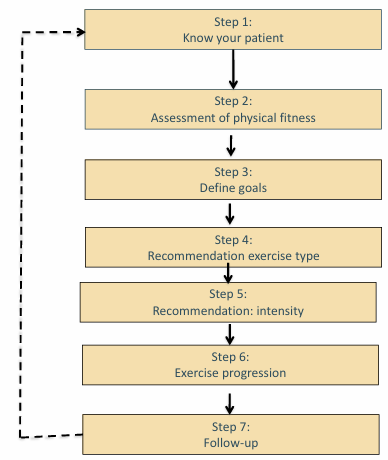
Step 1: Know your patient
Aim
- Eligibility for exercise testing and training?
- Contraindications
- level of supervision needed?
Absolute contra-indications
- Acute MI (<2 days)
- High risk unstable angina
- Uncontrolled cardiac dysrhythmias
- Active endocarditis
- Symptomatic or severe heart valve stenosis
- Decompensated symptomatic heart failure
- Acute pulmonary embolus or pulmonary infarction
- Acute noncardiac disorder that may affect exercise performance or be aggravated by exercise
- Acute myocarditis or pericarditis
- Physical or mental disability that would preclude safe and adequate test performance
- Resting hypoxia with Sa <85%
Relative contra-indications
- Left main coronary stenosis or equivalent
- Moderate stenotic valvular heart disease
- Electrolyte abnormalities
- Tachyarrhythmias or bradyarrhythmias
- Atrial fibrillation with rapid ventricular rate
- Hypertrophic cardiomyopathy
- High degree AV block
- Severe resting arterial hypertension (SBP > 200mmHg, DBP > 110mmHg)
Content
- Why
- Reason for visit/referral
- Who
- demographics
- age
- sex
- mental/social status
- ...
- cardiovascular risk factors
- co-morbidities
- medication and devices
- lifestyle including physical activity
- demographics
- What to evaluate
- personal and medical history
- physical examination
- clinical examination
Step 2: Assess CPET + other relevant (fitness) tests
Aim
- Screening purposes
- Measure peak VO2 and other prognostic markers
- Underlying cause of exercise intolerance
- To identify strength and weaknesses
- Optimise exercise prescription
- Baseline and follow-up data to evaluate the progress of exercise program
Content
- Cardiorespiratory
- Maximal aerobic power
- Submaximal functional tests
- Muscular fitness
- Isometric strength
- Muscular strength
- Muscular endurance
- Power
- Morphological
- Body composition
- Body mass
- Flexibility
- Bone density
- Motor
- Balance
- Coordination
- Agility
- ...
Goals - of Step 1 and 2
- SMARTER
- S: Specific
- M: Measurable
- A: Attainable
- R: Relevant or realistic
- T: Timely
- E: Evaluate
- R: Revise
Step 3.1: Exercise Prescription
Always apply basic principles of exercise program design
- Principle of interindividual variability
- Specificity -of- training principle
- Overload training principle
- Principle of Progression
- Principle of Initial values
- Principle of Diminishing returns
- Principle of Reversibility