- Evidence leads us to propose a new list of tips for health that speaks more clearly to the data from Holt-Lunstad et al (2010)
- 10 social identity tips for better health
- If you feel socially isolated, try to join a group
- If you can, join more groups
- Try to hold on to positive group memberships, especially if you are going through a challenging time
- If you lose membership in an important group, seek out a new one
- Invest in groups that are important to you and in groups by which you are valued
- Be wary of groups that make unhealthy choices
- Get support from your groups, but also give support to others in your groups
- Recognise that it can sometimes be healthy to try to leave disadvantaged and stigmatised groups, while at other times it can also be healthy to stay
- Challenge the stigma and disadvantage that produce health inequality
- If you experience health problems seek professional help - ideally from a source with which you identify
Situated Identity Enactment Model
- Focuses on the importance of social identity and social norms in physical activity
- It's very important to analyse the specific social context that provides cues to
- specific social identities - Who am I?
- and specific norms - What do we do?
- Identity + Norms from an ingroup lead to behaviour (ex: physical activity)
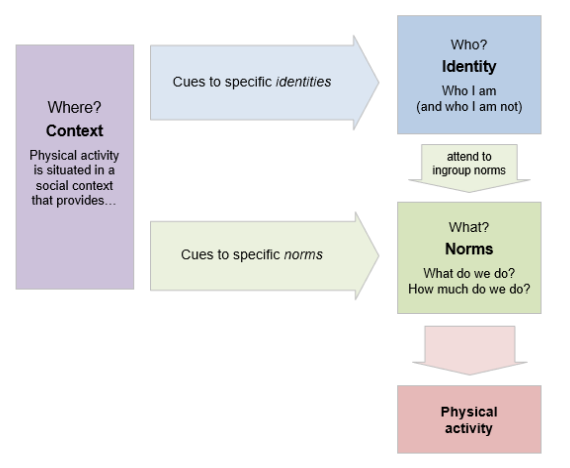
- It's very important to analyse the specific social context that provides cues to
Tips for giving social/identity meaning to physical activity
- Tip 1:
- Activate/point to a meaningful group/social identity (individual to that person), for which PA constitutes a behavioural norm. This entails getting to know our patient
- Ex: Linking a previous profession or their role in their family to physical activity
- Activate/point to a meaningful group/social identity (individual to that person), for which PA constitutes a behavioural norm. This entails getting to know our patient
- Tip 2: Point to social norms about PA
- Descriptive norms: the perceived standard behaviour of the members of the relevant group that you belong to (e.g., seeing that the majority of your age peers use the bike as a transportation method).
- Injunctive norms: the behaviour that you believe that members of your group ought to perform (e.g., believing that your age group cannot be active anymore). These are more powerful that the descriptive norms.
- Tip 3:
- Use physical activity as a means to become socially connected, transforming the opportunity to connect into a motivator for PA
- Ex: The main motivator to participate in a 10-week programme was the social get-together that happened after the walk
- Use physical activity as a means to become socially connected, transforming the opportunity to connect into a motivator for PA
- Tip 4: Technology can also promote physical activity norms and social cohesion
Social support
Social support is one of the strongest predictors of PA: much more power when it comes from ingroup members (ex: teenagers with their peers)
- informational: e.g., providing relevant info on how to be PA
- tangible (financial, logistic, …): e.g., driving your children to the sports club
- emotional: e.g., active listening when problems emerge, showing empathy, encouraging them, …
- companionship (doing it together): e.g., jogging together with a friend